History
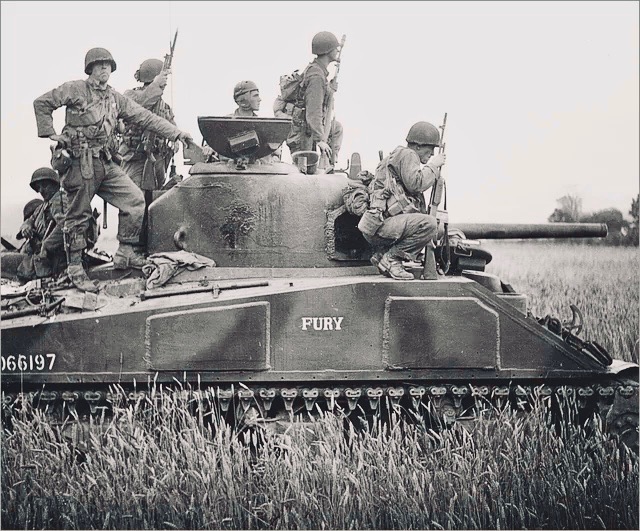
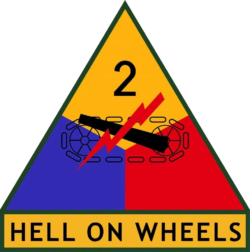
The Second Armored Division, also known as “Hell on Wheels,” was officially activated on July 15, 1940, at Fort Benning, Georgia, under the command of Maj. Gen. Charles L. Scott. Training the division fell to Col. George S. Patton Jr., a key figure in the development of armored warfare. Patton, promoted to brigadier general, took over as division commander in November 1940 when Scott was reassigned. Under Patton’s dynamic leadership, the division conducted intensive training exercises and participated in large-scale maneuvers across Tennessee, Louisiana, Texas, and the Carolinas. During this period, Patton reportedly coined the nickname “Hell on Wheels,” which later inspired the division’s patch design.
The division played a prominent role during World War II, spanning operations across North Africa, Europe, and multiple countries. On November 8, 1942, it participated in the invasion of North Africa, capturing Casablanca. Following this success, the division joined the invasion of Sicily in July 1943, engaging the elite Hermann Göring Panzer Division. In late 1943, it relocated to England to prepare for the Normandy invasion. Landing on Omaha Beach three days after D-Day, the division fought at Carentan and contributed to the decisive breakthrough at St. Lo. It advanced through France, crossed the Seine near Paris, pushed through Belgium, breached the Siegfried Line, and entered Germany. During the Battle of the Bulge, the division operated as part of Montgomery’s Twenty-first Army Group, later advancing to cross the Rhine under heavy enemy fire and covering significant ground in just a few days. On July 4, 1945, it became the first U.S. unit to enter Berlin.
Throughout the war, the division earned widespread recognition for its valor, receiving over 9,000 awards, including two Medals of Honor and more than 2,000 Silver Stars. In 238 days of combat, it suffered 7,348 casualties, including 1,160 killed in action. The division returned to the United States in 1946 and was stationed at Camp Hood, Texas, for retraining and rebuilding.
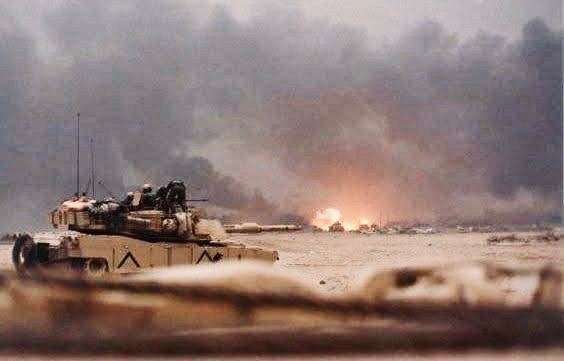
During the Korean War, the division supported the U.S. military by providing trained personnel for deployment. It was later stationed in Germany from 1951 to 1957 as part of NATO’s defense strategy. Elements of the division contributed to the Vietnam War effort, while the entire division periodically participated in major training exercises, including deployments to Europe during the Cold War. In 1990, the division deployed to Saudi Arabia for Operation Desert Shield, later participating in the swift and decisive Operation Desert Storm, liberating Kuwait in just 100 hours of combat.
The process of inactivating the division began in 1990 but was temporarily paused due to its involvement in Desert Storm. Following its return, the division was officially inactivated on May 2, 1991, after 51 years of continuous service. Several of its units were redesignated and integrated into other formations, ensuring its legacy continued.